
Paving
Hanpave
Porous paving system for parking lots, fire routes and LID schemes
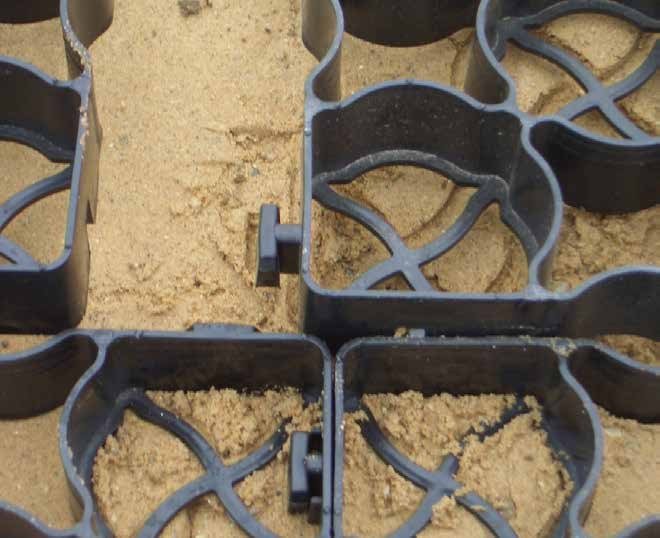
Hanpave arrives pre-assembled in 10.8 ft² sections that click together over a porous bedding. Filled with gravel or grass it carries vehicles, meets Low Impact Development goals and can contribute LEED credits — a three-person crew can lay 3,000–4,000 ft² per day.

Key facts
- Tested to DIN EN 124 and Copro PTV 828, surpassing both standards
- Supplied pre-assembled in 3 x 3 unit (10.8 ft²) sections
- Installs on slopes up to 15° without staking
- Absorbs up to 1/16” of thermal movement per unit
- Contributes to LEED credits and LID compliance
Best for
Specifications
- Nominal size
- 13” x 13” x 1⅝”
- Unit weight
- 1.26 lbs (11.3 lbs per 39” x 39” panel)
- Coverage
- 1.18 ft² per unit
- Compressive strength
- 360 psi empty / 580 psi topsoil / 810 psi gravel
- Max load per unit
- 60,840 – 136,900 lbs depending on fill
- Infiltration rate
- 196”/hr with gravel fill
- Connection
- Integral T connector and slots
- Color
- Black or green
- Surface finish
- Gravel or grass
- Units per pallet
- 486 units, 660 lbs
- Material
- 100% recycled polyolefins
- Compliance
- Americans with Disabilities Act (USA)
Advantages and trade-offs
Every surface is a compromise. Here is where Hanpave performs, and where another product in the range is the better call.
Advantages
Strength with flexibility
PTV 828 tests both load capacity and the strength of the interlock under power-steering loads. Rigid grids crack; Hanpave passed both.
The fastest product to lay
Pre-assembled 10.8 ft² sections mean a three-person crew can cover 3,000–4,000 ft² in a day.
Stormwater credit where it counts
196”/hr infiltration with gravel fill helps developments manage runoff volume and quality on site rather than piping it away.
ADA-compliant surface
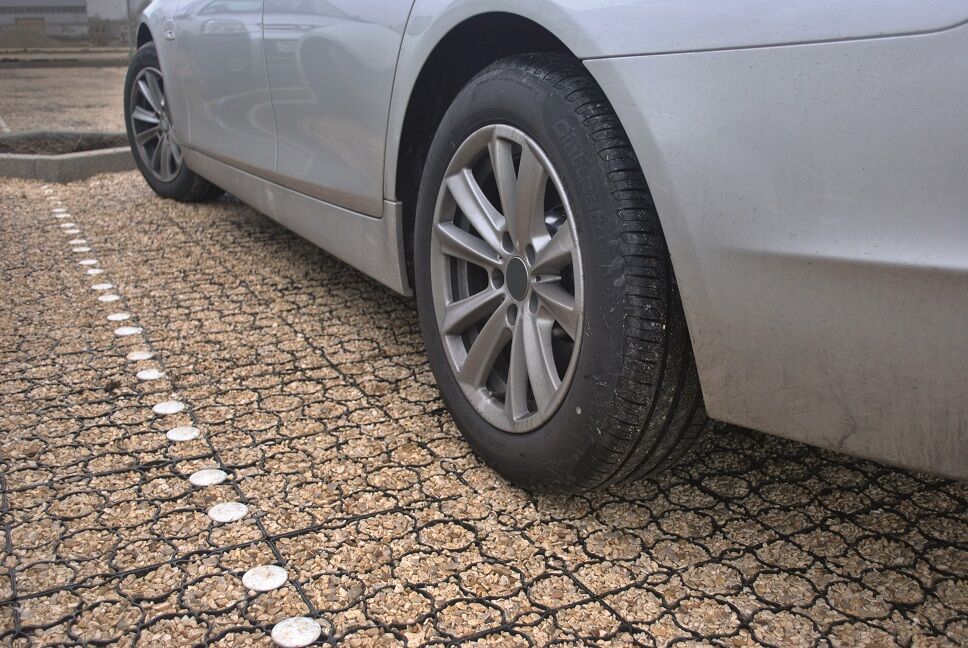
With the right fill it works for accessible parking, walkways and wheelchair routes, including white circular parking markers.
Considerations & limitations
Regular truck traffic needs HDGG instead
hanit's own guidance is to use Heavy Duty Ground Grid where regular trucks or coaches are expected; Hanpave is designed for cars with occasional trucks.
Sub-base depth drives the budget
On weak subgrades (CBR 1–2) a fire route can need up to 28” of base without a geogrid. Soil testing matters.
Not every soil suits infiltration
Sandy clay, silty clay and heavy clay are not suitable for LID infiltration; those sites need a sealed geomembrane and an outlet.
Edge detailing is required
A 1” gap filled with gravel or topsoil must be left between Hanpave and any curb or hard edging to absorb expansion.
In use
Typical applications
- Commercial and mall parking lots
- Fire routes and emergency access
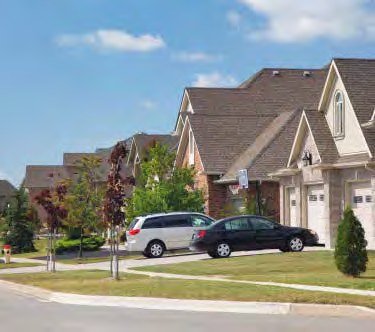
- Residential driveways and streets
- RV parks, showrooms and sports centers
- Golf cart paths, cycle routes and bridleways
- Helicopter pads and airport parking
Installation
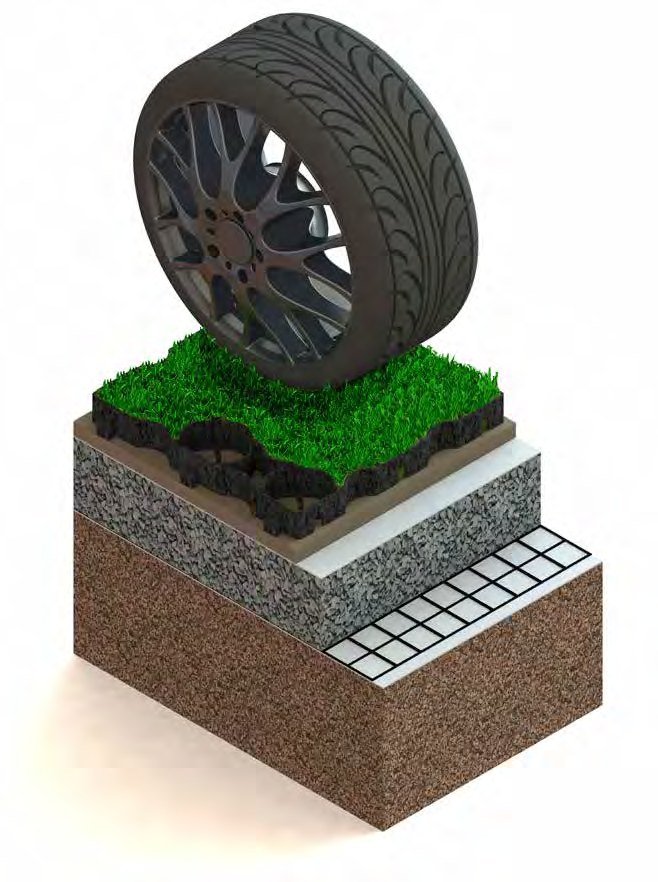
- 01Sub-baseCompacted free-draining engineered base, minimum 4”, sized from the CBR of the subgrade.
- 02GeotextileNon-woven needle-punched separation layer, with optional geogrid to reduce base depth.
- 03BeddingSharp sand compacted to 1¼”, or grit as an alternative.
- 04Click togetherLay pre-assembled sections and connect with the integral T connectors.
- 05Fill⅜” angular gravel or a 60:40 root-zone for grass — allow 0.31 yd³ per 100 ft².
- 06Attenuation optionWhere infiltration is not permitted, add a sealed geomembrane and direct water to an outlet.
Engineering data — hanit® 3 material test values
| Flexural stress (23 °C) | approx. 2,320 psi |
| Flexural stress (-5 °C / 65 °C) | approx. 2,900 / 1,450 psi |
| E-modulus, flexural (23 °C) | approx. 188,500 psi |
| Tensile strength | approx. 1,740 psi |
| Compression strength | approx. 2,320 psi |
| Charpy impact strength | no break |
| Shore D hardness | approx. 62 |
| Density | approx. 58 lb/ft³ |
| Water absorption | < 1% |
| Thermal expansion | approx. 0.00008 in/in·°F |
| Screw pull-out force | high — accepts standard wood screws |
Indicative values converted from the hanit® 3 material data sheet. Contact Effectus Corporation for project-specific engineering support.
Compare with
Ground reinforcement
Heavy Duty Ground Grid
Permeable reinforcement built for trucks, fire lanes and constant traffic
Ground reinforcement
Mud Control Grids
Ground reinforcement that lays straight onto mud — no ground preparation
Ground reinforcement
Paddock Slab
Permanent honeycomb ground management for arenas, paddocks and yards
Stocked in Texas. Quoted the same week.
Tell us the area you need to cover and we will come back with product options, pallet quantities and freight.