
Ground reinforcement
Mud Control Grids
Ground reinforcement that lays straight onto mud — no ground preparation
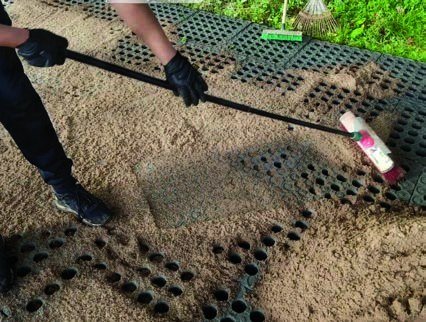
The fastest fix for a mud problem. Mud Control Grids (Mud Mats) can be laid directly onto soft ground in most horse and tractor applications, then filled and topped with sand to create a firm, free-draining surface at gates, feeders and high-traffic tracks.
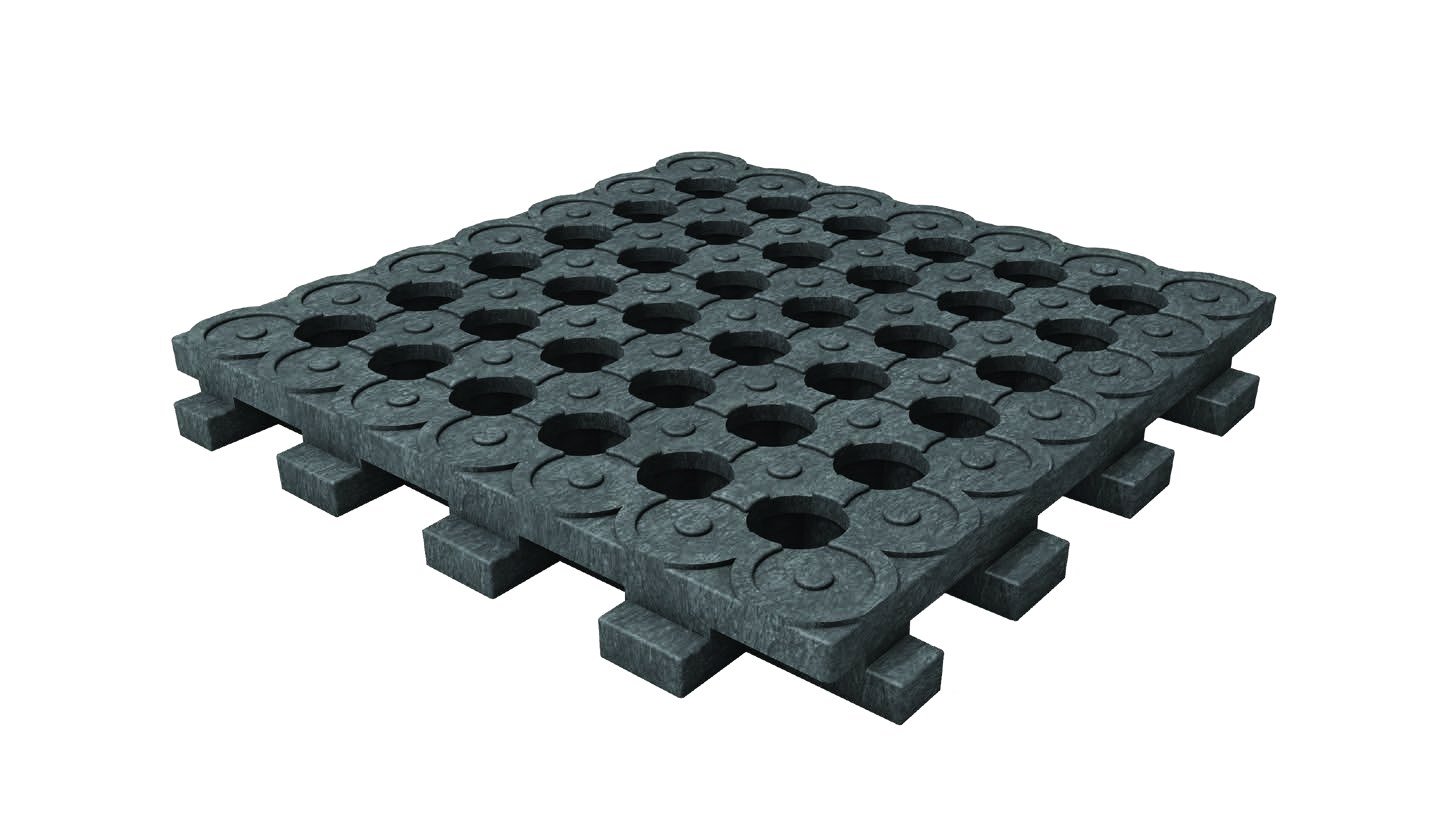
Key facts
- Minimal ground preparation required — in most cases, lay directly onto mud
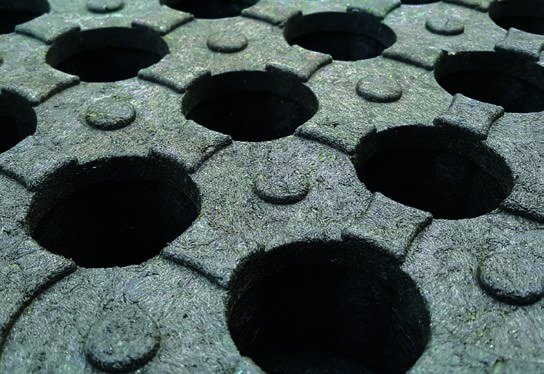
- 2” aperture is the ideal size for horse hooves
- Excellent water drainage through the surface
- Interlocking design installs and extends quickly
- 21 million square feet installed over the past 20 years
Best for
Specifications
- Length
- approx. 19½”
- Width
- approx. 19½”
- Height
- 2⅛”
- Weight per grid
- 14.8 lbs
- Weight per ft²
- 5.5 lbs
- Coverage per grid
- 2.64 ft²
- Grids per pallet
- 164
- Coverage per pallet
- 433 ft²
- Aperture
- 2”
- Load capacity
- Up to 5.6 tons per ft²
- Material
- 100% recycled plastic
- Connection
- Overlapping tabs
- Color
- Gray
Advantages and trade-offs
Every surface is a compromise. Here is where Mud Control Grids performs, and where another product in the range is the better call.
Advantages
Install without excavation
For horse and tractor use, grids can go straight onto the mud. That removes the biggest cost line in most ground-reinforcement projects.
Sized for hooves
The 2” aperture supports the hoof rather than trapping it, which is why this grid is the standard choice around gates, feeders and shelters.
Reversible
Grids can be lifted, moved and re-laid, so a rented property or a temporary yard is not a permanent commitment.
Cost-effective across its life
No rot, no rust, no annual resurfacing — maintenance is topping up the sand layer.
Considerations & limitations
A sand topping is mandatory for animals
hanit requires a 2–4” topping layer of quarried sharp sand wherever animals or livestock use the surface, and it needs topping up each year.
Very soft ground still needs help
On heavy clay or very boggy ground you should add a gravel or wood-chip base and a needle-punched geotextile, or the fill will migrate into the subgrade.
Expansion gaps matter
Grids expand 1/16” per unit per 50°F, so a ¼” gap between grids is required. Skipping it causes lifting in Texas summer heat.
Not intended as a vehicle parking surface
For sustained truck or car parking, Heavy Duty Ground Grid or Hanpave is the correct product.
In use
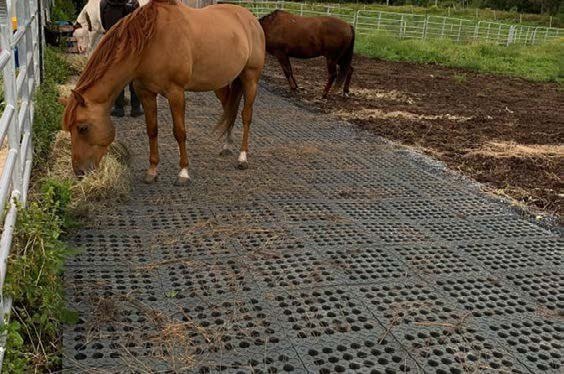
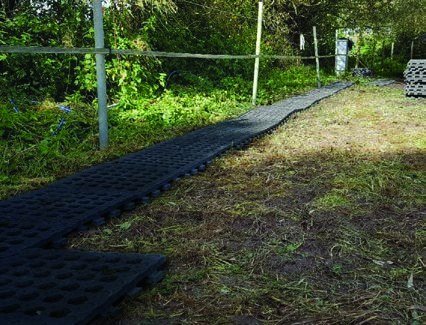
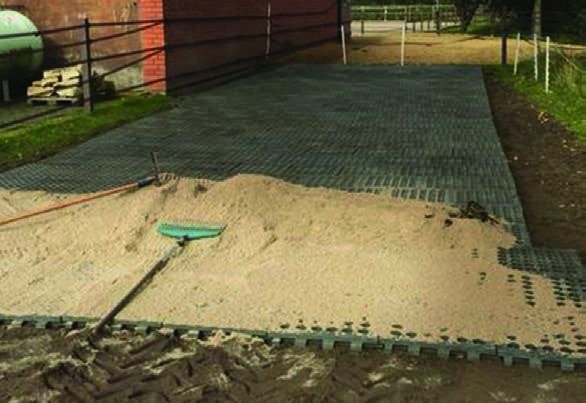
Typical applications
- Gateways, feeding stations and water troughs
- Horse turnout and loafing areas
- Walkways and tracks between paddocks
- Livestock pens and pathways
- Kennels, runs and animal enclosures
- Temporary access for equipment
Installation
- 01Optional baseFor very soft ground, add a 2” gravel layer or 2–4” of wood chips for a flexible base.
- 02Level the areaMark out, level, and fill dips with granular material. On heavy clay, lay a 3.5 oz non-woven needle-punched geotextile with 6” overlaps.
- 03Set the lineUse a string line for level and alignment, leaving a ¼” gap between grids.
- 04Stagger the bondStart the second row with a half grid — grids cut with a circular or bench saw just like hardwood.
- 05FillFill the cells with coarse sharp sand or ¼–⅝” gravel. One ton fills roughly 140 grids (375 ft²).
- 06Top offAlways finish with a 2–4” layer of quarried sharp sand where animals use the surface, and top up annually.
Engineering data — hanit® 3 material test values
| Flexural stress (23 °C) | approx. 2,320 psi |
| Flexural stress (-5 °C / 65 °C) | approx. 2,900 / 1,450 psi |
| E-modulus, flexural (23 °C) | approx. 188,500 psi |
| Tensile strength | approx. 1,740 psi |
| Compression strength | approx. 2,320 psi |
| Charpy impact strength | no break |
| Shore D hardness | approx. 62 |
| Density | approx. 58 lb/ft³ |
| Water absorption | < 1% |
| Thermal expansion | approx. 0.00008 in/in·°F |
| Screw pull-out force | high — accepts standard wood screws |
Indicative values converted from the hanit® 3 material data sheet. Contact Effectus Corporation for project-specific engineering support.
Compare with
Stocked in Texas. Quoted the same week.
Tell us the area you need to cover and we will come back with product options, pallet quantities and freight.