
The material
Why hanit® recycled plastic
hanit® is a structural polymer made entirely from post-consumer plastic waste. It works like wood on site and behaves like plastic in the ground — which is exactly what a Texas paddock, driveway, industrial yards, or commercial parking lots need.
Eco-friendly
- 100% post-consumer recycled plastic, 100% recyclable again
- Blue Angel eco-label certified
- Non-toxic per DIN EN 71-3 — harmless to flora, fauna and groundwater
- Diverts plastic waste from landfill instead of quarrying aggregate
Durability
- Rot-free: no decay, no splintering, no insect damage
- Frost and UV resistant with no sealing or painting
- Resistant to oils, brines, acids and salt water
- Water absorption under 1% — it does not swell or spall
Economical
- No annual resurfacing, sealing or repainting cycle
- Maintenance is limited to topping up fill material
- Reusable and relocatable — lift and re-lay rather than demolish
- 20-year warranty on the material
Lightweight
- Roughly one third the weight of an equivalent concrete product
- Lower freight cost per square foot of coverage
- Units sized for NIOSH-compliant manual handling
- Smaller crews and no heavy lifting plant on most jobs
Simple processing
- Cut, drill and screw with standard woodworking tools
- Works like timber — no specialist masonry trades
- Accepts wood screws with high pull-out resistance
- Note: angle grinders are unsuitable for cutting hanit®
Safety & maintenance
- Shatterproof — it flexes rather than cracking
- No frost spalling, efflorescence or loose concrete fragments
- Permeable surface reduces standing water and ice sheets
- Stable footing for hooves, tires and foot traffic
How it's made
From mixed plastic waste to a load-rated element
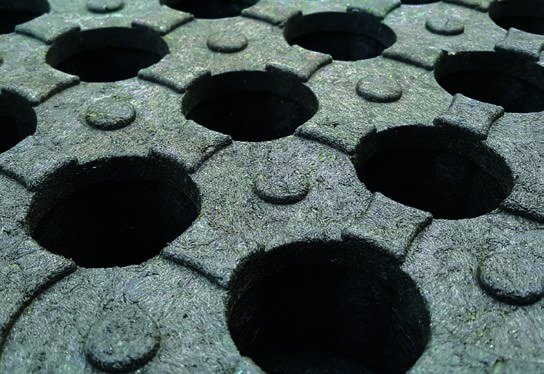
Post-consumer plastics are sorted, shredded, washed and homogenized, then melted and injected into steel molds under pressure. The result is a dense, homogeneous element with consistent structural properties — no fillers, no reinforcement, no coatings to fail.
- 01Collect & sortMixed post-consumer plastic waste is collected and separated by polymer type.
- 02Shred & washMaterial is shredded to flake, washed and dried to remove contaminants.
- 03HomogenizeFlake is blended to a controlled recipe so every batch performs the same.
- 04MoldThe melt is injected into steel molds and cooled under pressure.
- 05Recycle againAt end of life, elements are ground and returned to the process.
How it works
Load distribution and drainage, in plain language
Load distribution
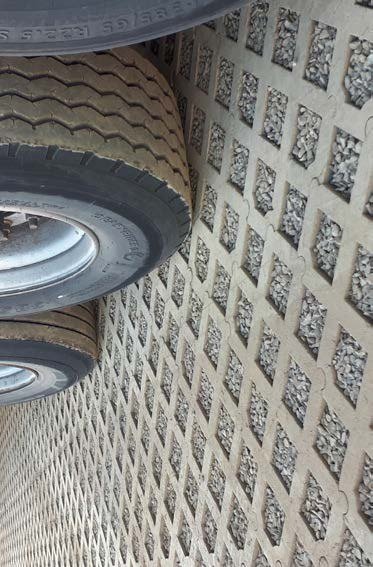
A hoof or a tire concentrates enormous pressure on a small patch of ground. The grid's cell walls take that point load and spread it sideways across the whole panel and into the fill and base beneath. The ground never sees the point pressure, so it never churns into mud.
Drainage
Rain passes through the open cells and the granular fill rather than sheeting off. That keeps the surface dry underfoot, reduces runoff volumes for stormwater compliance, and stops the freeze-thaw and erosion cycle that destroys compacted-dirt surfaces.
Stocked in Texas. Quoted the same week.
Tell us the area you need to cover and we will come back with product options, pallet quantities and freight.